
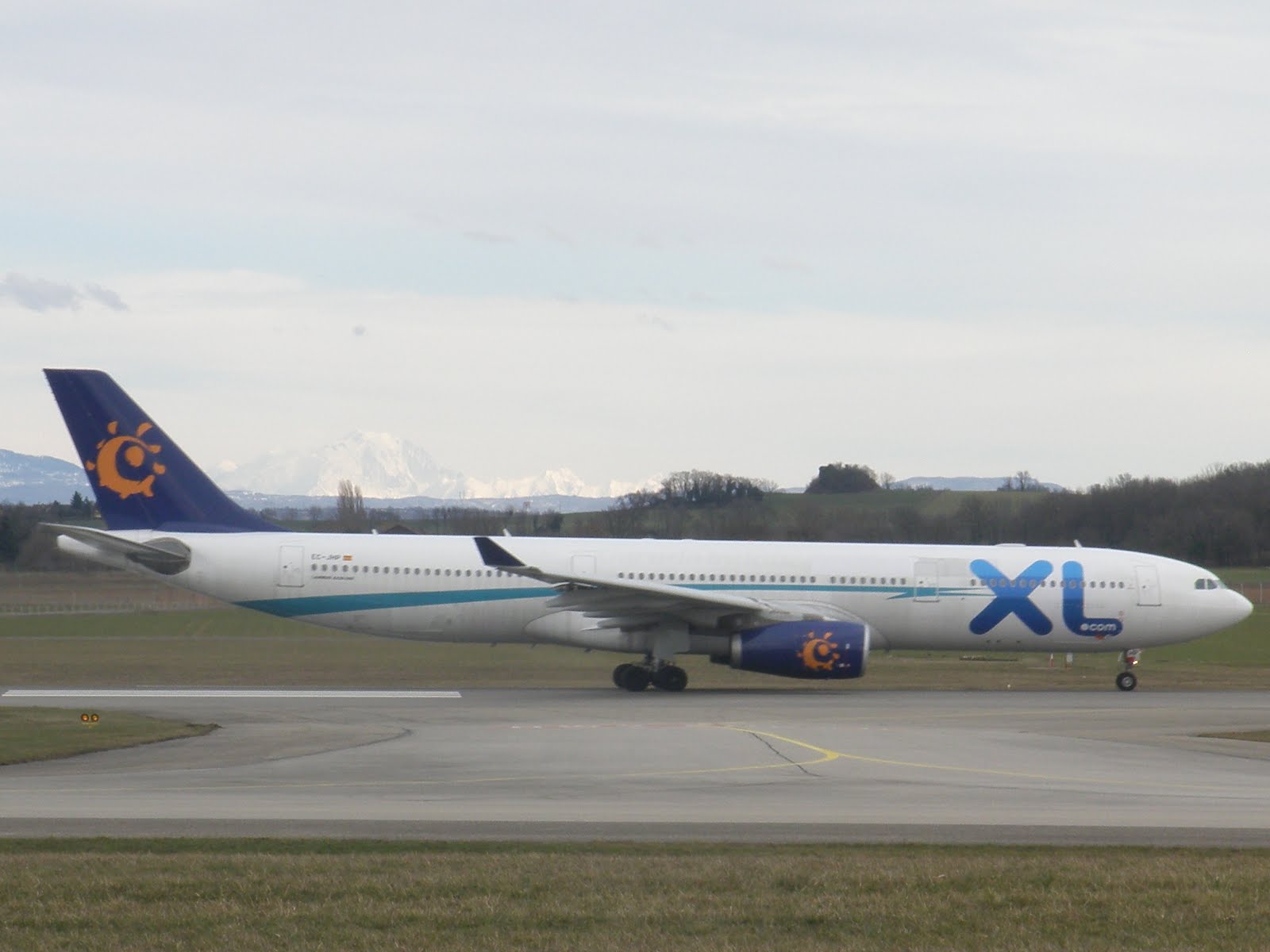

 Encore un…

Another ...
CTL: "N123YZ, announce altitude"
N123YZ: "Altitude!"
CTL: "N123YZ, announce speed"
N123YZ: "Speed!"
CTL: "N123YZ, say" request cancellation of the flight plan. "
N123YZ: "er, 8000 feet, 150 kts sir."
Voice of the captain: "Roger, I arrive at 3000 feet above the NF tag."
Another voice on the radio: "NO! You can not do that, I'm at 3000 feet above the tag!
(quick break, then answer the voice of the captain) "You idiot, you're my first officer!"
Pilot: "Good morning Frankfurt, KLM 242 request permission to start."
Tower: "KLM 242, because of the slot, 2 hours waiting for the start."
Pilot: "Confirm TWO HOURS of waiting?"
Tower: "Affirmative."
Pilot: "In this case, cancel the 'good morning'!"
Heard at the Frankfurt airport, between a British Airways pilot and German controller...
Speedbird: "Good morning Frankfurt, Speedbird 206 ready to go."
Control: "Guten morgen, go to your terminal.
The 747 goes in the middle of the main taxiway and stops.
Control: "Speedbird, you know where you going??"
Speedbird: "Standby control, I look a bit location of the terminal there."
Control (with the traditional German impatience): "Speedbird, you're never been to Frankfurt before?!"
Speedbird (casual): "Yes, in 1944, but I have not stopped. »


 Pour communiquer avec le sol, depuis un avion, il n’existe pas beaucoup de moyen…
 Depuis les débuts de l’aviation, seul la radio VHF permet aux avions de communiquer de façon satisfaisante avec le contrôle aérien.
La réception n’étant pas toujours parfaite, et pour éviter des erreurs pouvant avoir des conséquences terribles (Tenerife 1977), une phraséologie précise doit être appliquée pour toutes les communications radio.
Je vais aborder aujourd’hui la base de cette phraséologie : l’alphabet international.
Lors d’une communication, un avion doit s’identifier en donnant son immatriculation. Mais imaginez si la réception n’est pas très bonne et que deux avions se présentent en même temps, l’un immatriculé F-MTDS, et l’autre S-NDTF. Prononcez à haute voix, et vous vous rendrez compte que la confusion est possible… En effet, en Français, et comme dans d’autres langues, certaines lettres ont une prononciation proche. Pour éviter tous risques de confusion, on utilise l’alphabet international.
Dans mon exemple, les avions s’appelleront donc Fox MikeTango Delta Sierra et Sierra November Tango Fox.
Déjà plus difficile à confondre, non?
L’avantage incontestable de l’alphabet international par rapport au morse est qu’il est facilement compréhensible par tous.
Pour information, toutes les lettres de cet alphabet:
Alpha
Bravo
Charlie
Delta
Echo
Foxtrot
Golf
Hotel
India
Juliet
Kilo
Lima
Mike
November
Oscar
Papa
Québec
Roméo
Sierra
Tango
Uniform
Victor
Whisky
X-Ray
Yankee
Zulu
Aucune confusion possible. Couramment, Foxtrot est raccourci en Fox, et pour les pays francophone, November est transformé en Novembre…
Durant les quelques semaines qui viennent, je serais en déplacement professionnelle...
Ainsi, je continuerais à publier des messages, mais ils sont programmés et publiés de façon automatique...


To communic with the ground from an airplane, there is not many way...
Since the early days of aviation, radio VHF are the only devices who allows aircraft to communicate adequately with air traffic control.
The reception is not always perfect, and to avoid errors that could have horrific consequences (Tenerife 1977), a precise phraseology should be applied to all radio communications.
I will address today the basis of this phraseology: the international ABC.
During a call, an aircraft must be identified by giving its registration number. But imagine if the reception is not very good and that two aircraft are at the same time, one registered F-MTDS and the other S-NDTF. Say it for yourself, and you'll realize that confusion is possible ... In fact, in French, as in other languages, some letters have similar pronunciation. To avoid confusion, we use the international ABC.
In my example, the first aircraft is called Fox Mike Tango Delta Sierra and the second one Sierra November Delta Tango Fox.
More difficult to confuse on that way, no?
The undoubted advantage of the international ABC from the other sign used is that it is easily understandable by all.
For information, all the letters of the ABC:
Alpha
Bravo
Charlie
Delta
Echo
Foxtrot
Golf
Hotel
India
Juliet
Kilo
Lima
Mike
November
Oscar
Papa
Québec
Roméo
Sierra
Tango
Uniform
Victor
Whisky
X-Ray
Yankee
Zulu
No confusion possible. Currently, Foxtrot is shortened in Fox, and for french speaking country, November is converted in Novembre...
Note: during the few next weeks, i will be in working trip, don't worry, some messages are already programmed... See you soon!


 L’absence de concurrent direct et des couts de maintenance réduit on fait de cet avion une réussite commerciale, avec 283 unités livrées.
  Les améliorations apportées aux Boeing 737 et l’apparition de l’Airbus A319 au début des années 90 affectèrent la carrière commerciale de ce modèle. La production fut arrêtée en 1997.
 Air France et ces partenaires (Brit Air principalement) retirent actuellement leurs Fokker 100, au profit d’Embraer (170 et 190) et de Bombardier CRJ. Le dernier vol sera effectué dans l'année...
  La raison ? Le siège 23A que j’occupais est placé directement au niveau du réacteur arrière gauche, et ne dispose pas de hublot…
 Pour finir, quelques chiffres:


 The review done on the Boeing 737 and the Airbus A319 launch on the early 90s affected the commercial success of this model. Production was stopped in 1997.
 For the story,I recently made a trip in a Fokker 100. This trip was one of the least pleasant of all those I ve ever make by plane! The reason? I occupied the seat 23A, that it is placed directly at the reactor back left, and who has no window ...
 Airbrake deployed, this airplane is braking at it's maximum capacities...
 After the short finale, it is time to do the round in order to tuch the rear wheel on the track...
 Embraer 145, Lyon Saint Exupéry.
 Airbus A321, Lyon Saint Exupéry.
 Airbus A318, Lyon Saint Exupéry
 Airbus A310, Lyon Saint Exupéry.
 CRJ 900, Lyon saint Exupery.
 Fokker 100, Lyon Saint Exupery.
 Alpha jet, Le Bourget, musée de l'air et de l'Espace.
 Boeing 737, Lyon Saint exupery.
 Boeing 747 & CRJ 100, Lyon Saint Exupery.
 Airbus A319, Lyon saint exupery.
 Avro RJ85, Lyon Saint Exupery.
 Dash 8, Limoges Bellegardes.
 Airbus A319, Naples.
 ATR 42, Paris Orly.
 Boeing 757, Lyon Saint Exupery.
 Cessna, Lyon Bron.
 Embraer 145, Nancy Metz.
 Course contre un TGV, Nancy Metz.
 Aibus A330, Lyon saint Exupery.
 Articles
Commentaires
Articles
Commentaires


